The insole that ships inside most basketball shoes is designed to keep manufacturing costs down, not to optimize your foot support over a two-hour run. Foam gets compressed, arch support flattens, and by midseason the factory insert is doing very little for the player actually wearing it. Replacing that insert with a purpose-built aftermarket insole is one of the most cost-effective upgrades available for any athlete who spends significant time on the hardwood.
Basketball-specific demands are real: repeated high-impact landings from jumps, explosive lateral changes of direction, hard stops from full sprint speed, and total session times that can exceed two hours between warm-up and game clock. Standard insoles handle none of those demands as well as insoles designed to support dynamic athletic movement, cushion high-impact heel strikes, and hold arch position through lateral cuts that strain the medial arch in ways that straight-line running does not.
This guide covers five of the best insoles for basketball shoes available on Amazon, chosen across different price tiers, arch profiles, and specific use cases-from the most reviewed insole on the planet to a basketball-specific product co-designed by NBA players.
FTC disclosure: This article contains affiliate links. We may earn a commission if you buy through them, at no extra cost to you.
Quick picks
| Insole | Best for | Price | Standout feature |
|---|---|---|---|
| Move Game Day | Best basketball-specific insole | ~$50 | NBA co-designed, composite heel, court-specific support |
| Superfeet Green | Best for high-arch support & durability | ~$60 | 33,900+ reviews, deep heel cup, rigid stabilizer cap |
| CURREX RunPro | Best for dynamic movement & arch-matched fit | ~$60 | Three arch profiles, 6,300+ reviews, athletic activity focus |
| Sof Sole Athlete | Best budget performance insole | ~$25 | 10,800+ reviews, gel heel/arch, lightweight PU foam |
| Dr. Scholl’s Sport | Best accessible everyday option | ~$21 | 13,600+ reviews, flexible lateral support, multi-sport design |
The 5 best insoles for basketball shoes
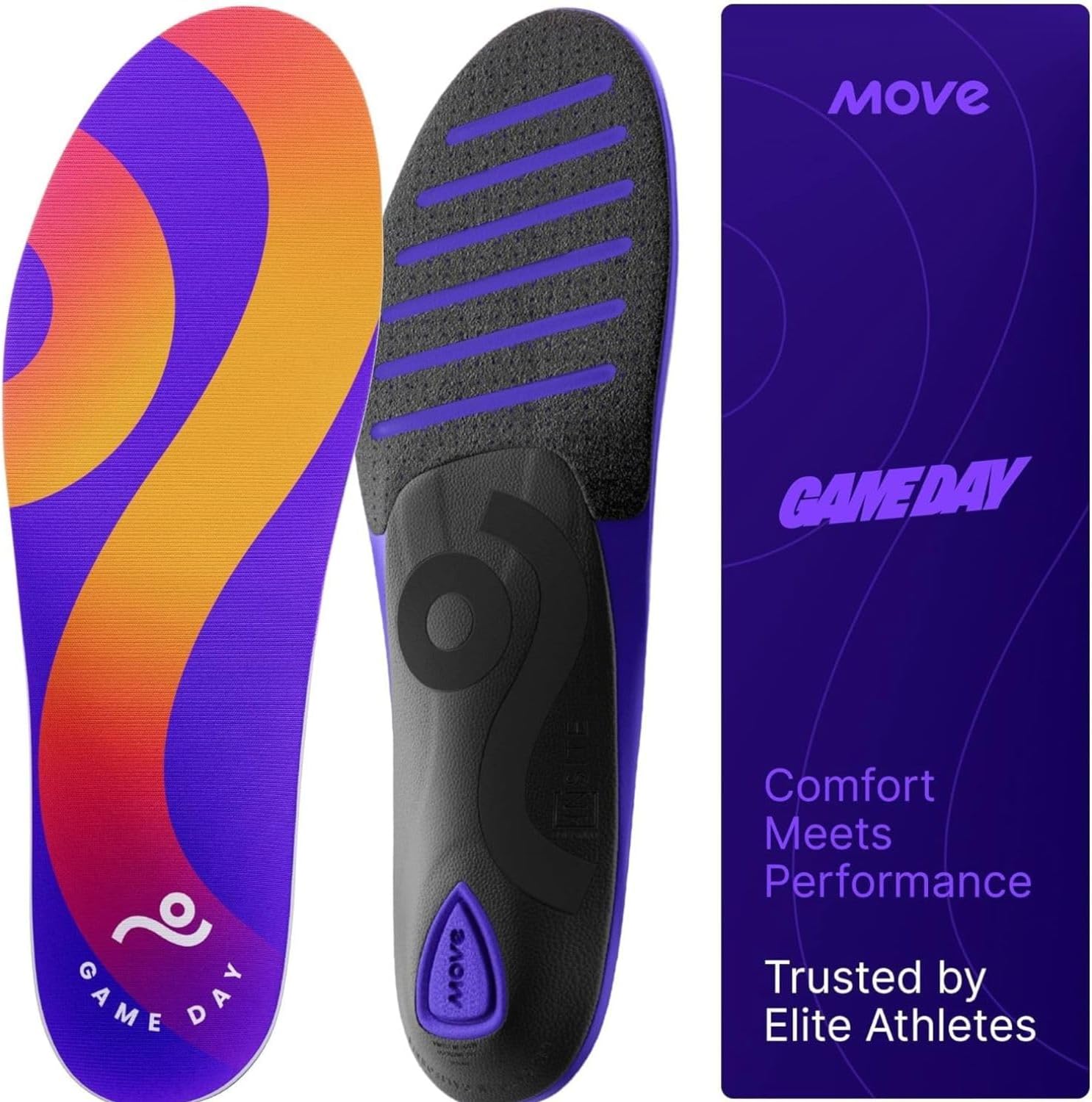
1) Move Game Day Performance Insoles – Best basketball-specific insole
The Move Game Day is the most directly basketball-targeted insole on this list, and the story behind it matters: Move was co-founded by NBA All-Pro Damian Lillard and was developed in collaboration with professional athletes who understood exactly what high-level basketball movement demands from an insole. That is not just marketing-it is a design brief that produced an insole optimized specifically for basketball’s combination of explosive vertical loading, sharp lateral cutting, and sustained court time.
The composite heel construction is the technical centerpiece. Basketball players absorb repeated high-impact heel strikes on hardwood-not the gradual impact of a run, but sudden, loaded landings from jumps that concentrate force in the heel and transmit it up through the ankle, knee, and hip chain. The Game Day’s composite heel is designed to absorb and redirect that impact energy specifically, reducing the accumulated stress on pressure points that creates fatigue and injury risk over a long session. The reactive stability design supports the arch through lateral cuts without the stiffness that would limit explosive movement off the planted foot.
With 760 reviews at a price point of around $50, the Game Day lands in a competitive tier against general-purpose athletic insoles. The differentiation is specificity: this is the insole built for basketball, not adapted from another sport’s requirements.
- Basketball-specific design: Engineered for hardwood court movement-not adapted from running or general athletic use.
- NBA player co-development: Co-founded by Damian Lillard and trusted by professional athletes who train and perform at the highest level.
- Composite heel impact protection: Designed specifically for the repeated vertical loading of basketball jumps and landings.
- Reactive stability arch support: Supports the medial arch through lateral cuts without limiting explosive push-off mechanics.
- Pressure relief technology: Active heel, ankle, and foot protection targeting the pressure points most stressed by basketball movement.
Best for: Serious basketball players who want an insole designed specifically for their sport and validated by professional athletes. The clearest recommendation when basketball performance is the primary criterion rather than general athletic or everyday use.
Worth knowing: At ~$50, the Game Day is mid-tier in price. Players who want the most reviewed general-purpose insole with proven long-term durability should look at the Superfeet Green. Players on a tighter budget have two solid options lower on this list.
See Current PriceOpens Amazon. Affiliate link.
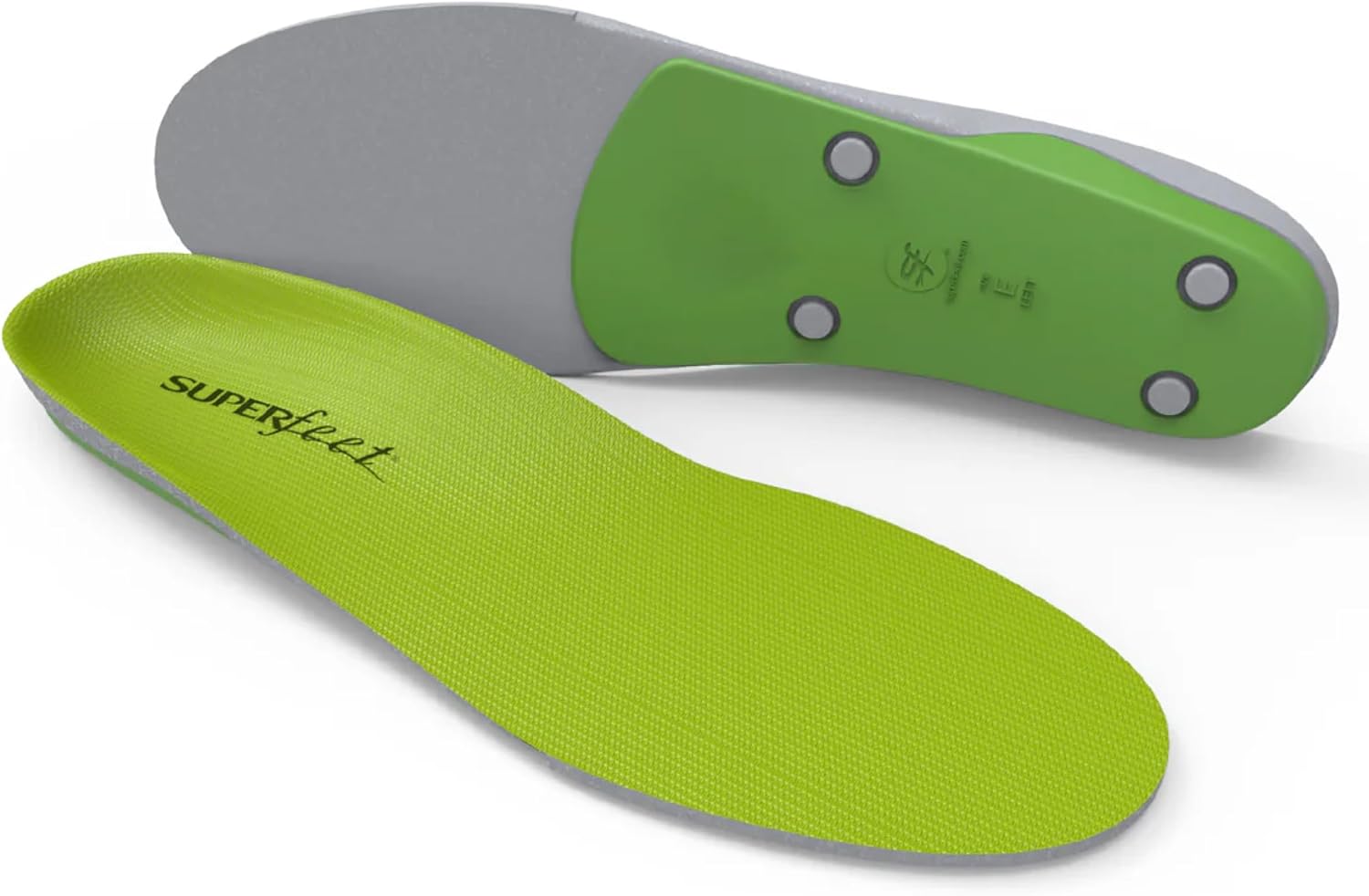
2) Superfeet All-Purpose High Arch Insoles (Green) – Best for high-arch support and long-term durability
The Superfeet Green (now sold as Superfeet All-Purpose High Arch) is the most-reviewed insole on Amazon-over 33,900 ratings-which makes it the most thoroughly validated aftermarket insole available anywhere at any price. That scale of real-world feedback means you are not relying on controlled testing or brand claims; you are buying into an insole with an extraordinary depth of user experience behind it.
The Green’s defining characteristic is its rigid stabilizer cap-a firm, structural base that supports the heel and arch in a way that foam-only insoles cannot replicate over time. Most foam insoles compress and flatten under repeated impact. The Superfeet Green’s stabilizer cap maintains its structural position through thousands of hours of use, which is why so many buyers report using the same pair for multiple seasons. For a basketball player who plays regularly throughout a season, that durability means consistent support rather than a gradual return to baseline as the foam compresses.
The deep heel cup works with the foot’s natural fat pad-concentrating the body’s own cushioning material under the heel where impact is highest-rather than substituting artificial foam for what the foot already provides. This biomechanically informed approach is what separates the Superfeet design philosophy from simpler gel-pad insoles that just add material without improving the foot’s natural mechanics.
- 33,900+ reviews-most validated insole on Amazon: Unprecedented real-world feedback depth across years of consistent buyer use.
- Rigid stabilizer cap: Structural base that maintains arch support through heavy use-does not compress flat over time like foam-only alternatives.
- Deep heel cup: Concentrates natural heel fat pad for maximum shock absorption-works with foot mechanics rather than replacing them.
- Long-term durability: Designed to outlast multiple pairs of shoes-the same insole works across multiple basketball shoe rotations.
- High-arch profile: Best for players with neutral-to-high arches who need structural support under load.
Best for: Basketball players with high arches who want the most proven insole available for long-term structural support and durability. Also the best choice for players who want to invest in one quality insole that moves across multiple pairs of shoes over a full season.
Worth knowing: Superfeet Green is a high-arch insole-it may feel too firm or too high for players with low or flat arches. Players with low arch profiles may find the CURREX RunPro’s arch-matched sizing or the softer Sof Sole Athlete a better fit for their specific foot shape.
Check PriceOpens Amazon. Affiliate link.
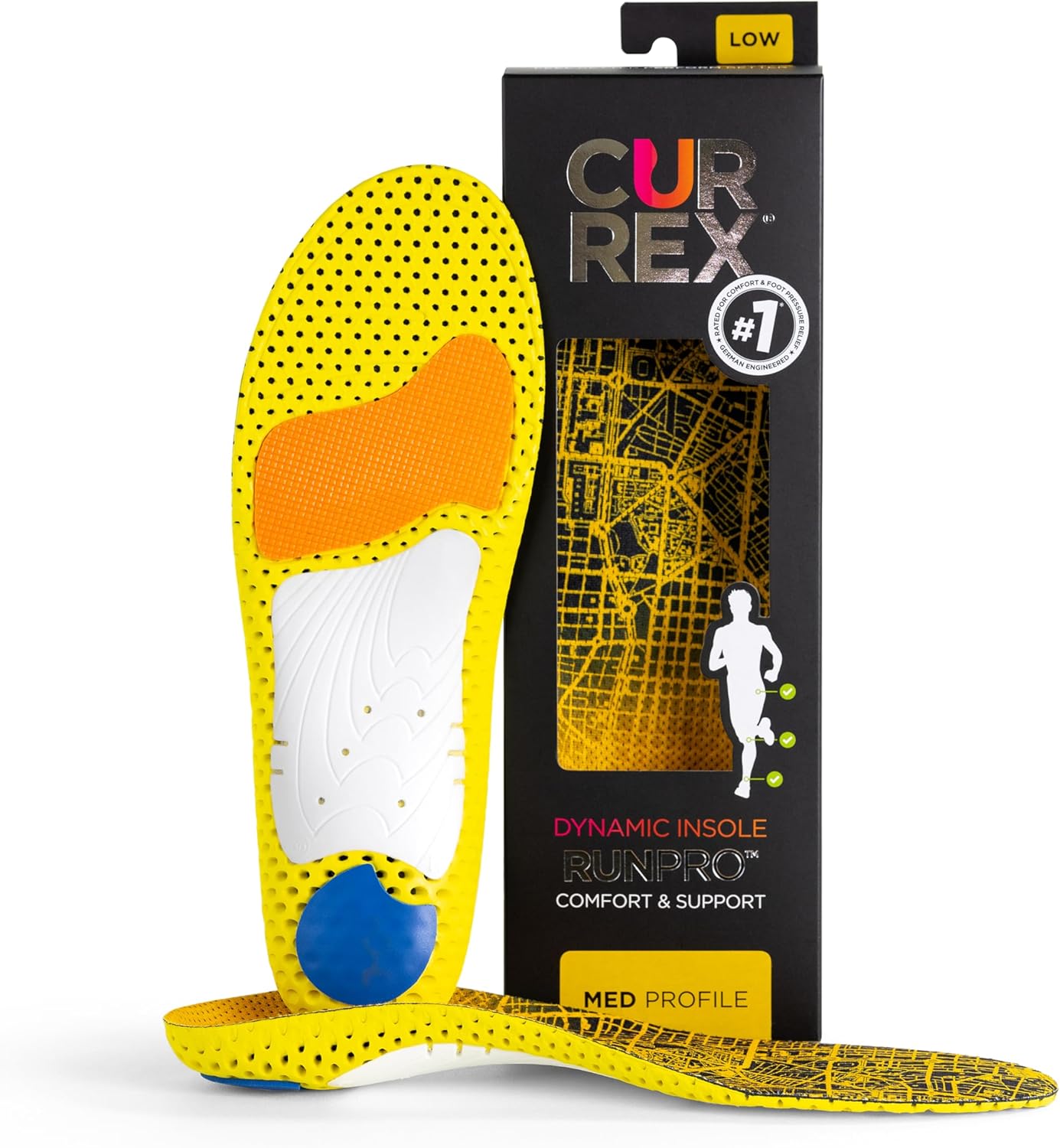
3) CURREX RunPro Insoles – Best for dynamic movement and arch-matched fit
The CURREX RunPro distinguishes itself through a detail most insole buyers overlook: it comes in three distinct arch profiles-low, medium, and high-rather than offering a single shape and expecting everyone to adapt to it. That arch profile selection matters significantly for how an insole actually performs in use. An insole designed for a high arch will bridge the contact zone of a low-arch foot, creating pressure points rather than eliminating them. CURREX’s approach of sizing to your specific arch type produces a more anatomically accurate fit for a broader range of players.
With 6,330 reviews, the RunPro has a deep validation base specifically from athletic users who put it through dynamic sport movement. Basketball’s lateral cutting, stopping, and direction-change demands share biomechanical characteristics with running-both require the arch to work efficiently through a range of loading positions-which makes a running-positioned performance insole genuinely applicable to basketball use. The RunPro’s focus on reducing fatigue and preventing injuries aligns directly with what basketball players need across a long season of repeated high-load sessions.
At ~$60, it sits at the premium end of this list, but the arch-matched design and performance validation at that price make it the most precise fit option for players who know their arch profile and want an insole engineered around it.
- Three arch profile options: Low, medium, and high-matched to your specific foot shape rather than a generic compromise.
- 6,330 reviews from athletic users: Extensive validation from dynamic sport use, not casual wear.
- Fatigue reduction focus: Engineered to reduce lower body fatigue during extended athletic sessions.
- Injury prevention design: Stability and support positioned to protect the arch and heel through repeated high-load athletic movement.
- Dynamic movement performance: Works for lateral cuts and direction changes-not optimized only for straight-line running mechanics.
Best for: Players who know their arch profile and want an insole precisely matched to their foot shape-particularly those with low arches for whom the Superfeet Green’s high-arch profile would be inappropriate. Also strong for analytically minded athletes who want to optimize every variable.
Worth knowing: CURREX sells by arch profile, not just size-you need to know whether your arch is low, medium, or high before buying. If you are unsure, a simple wet-foot test (wet your foot and step on brown paper) will show your arch shape clearly: a full footprint indicates low arch; a narrow midfoot connection indicates high arch.
See ReviewsOpens Amazon. Affiliate link.
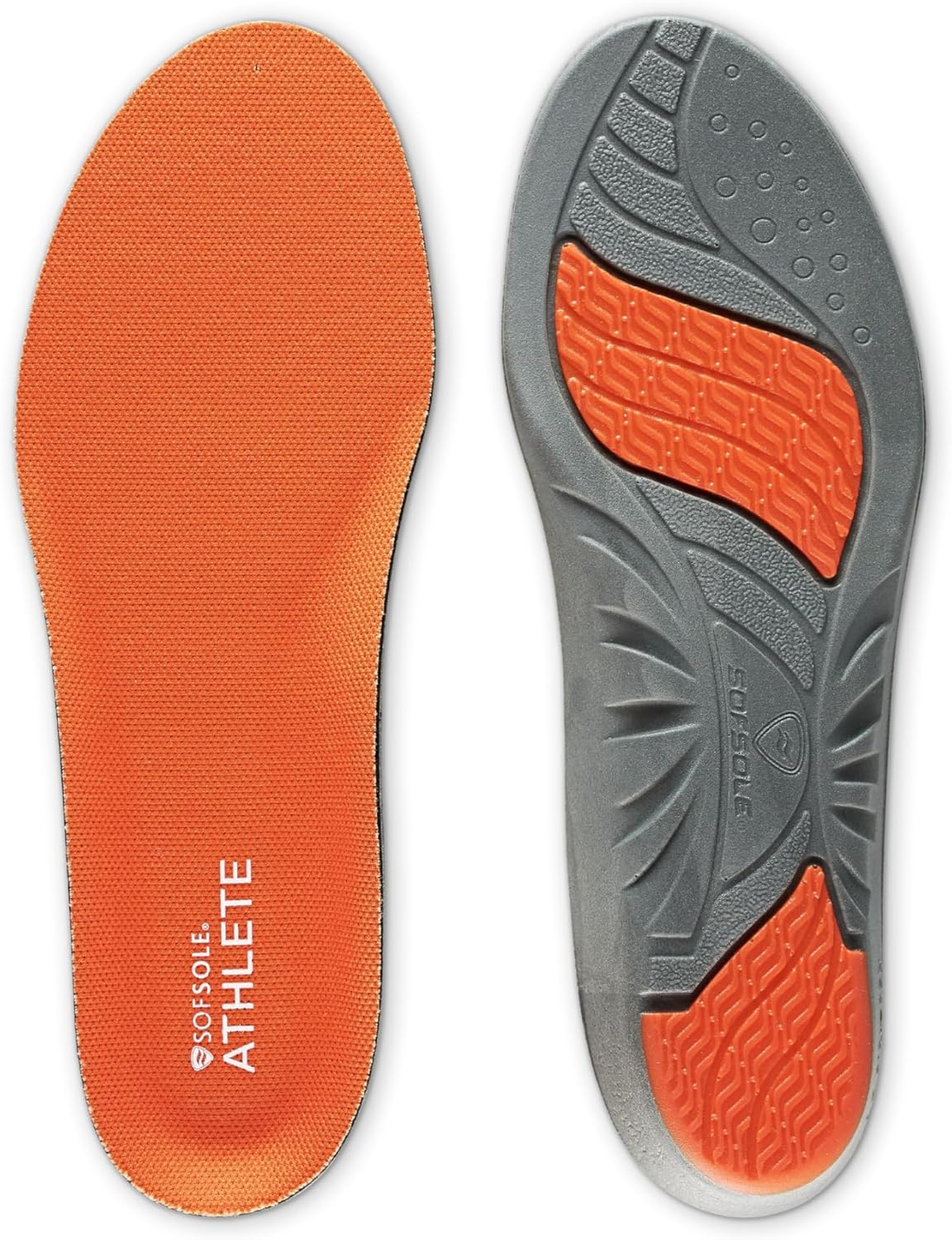
4) Sof Sole Athlete Performance Insoles – Best budget performance insole
The Sof Sole Athlete is the performance insole that makes upgrading accessible to every player regardless of budget. At around $25, it sits at less than half the price of the premium options on this list while still offering a genuine step up in cushioning, arch support, and moisture management over factory insoles. With 10,802 reviews, it is extensively validated as a consistent performer across athletic uses including basketball.
The construction combines PU (polyurethane) foam cushioning with gel pods at the heel and arch-the two locations where basketball players absorb the most impact. PU foam provides a more responsive, longer-lasting cushion than standard EVA foam (which compresses more quickly), and the gel pods add targeted impact absorption at the specific pressure points that basketball movement stresses most. Heel-to-toe cushioning coverage means the full contact surface is addressed rather than just the heel or just the arch. The moisture-wicking top cover addresses the hygiene concern that becomes relevant when insoles see heavy use multiple times per week.
For players who want to upgrade from factory insoles without spending $50-$60, or for players who want to stock multiple pairs of insoles for rotation across several pairs of shoes, the Sof Sole Athlete is the clearest answer.
- Best budget-to-performance ratio: ~$25 delivers meaningful improvement over factory insoles at less than half the premium tier price.
- 10,800+ reviews: Second-highest review count on this list-extensively validated at scale.
- PU foam + gel construction: More durable cushioning material than standard EVA foam, plus targeted gel pods at heel and arch.
- Heel-to-toe coverage: Full contact zone cushioning, not just targeted padding at specific points.
- Moisture-wicking top cover: Practical for players who use insoles through multiple sessions per week.
Best for: Budget-conscious players who still want real performance improvement over factory insoles, players who want to stock multiple insoles for rotation, and younger or recreational players who do not want to invest premium money in insoles yet.
Worth knowing: At the budget tier, the Sof Sole Athlete will compress more quickly than the Superfeet Green over time. Plan to replace it more frequently-approximately every 300-400 hours of court time rather than every 500-600 hours for a premium structural insole.
Check PriceOpens Amazon. Affiliate link.
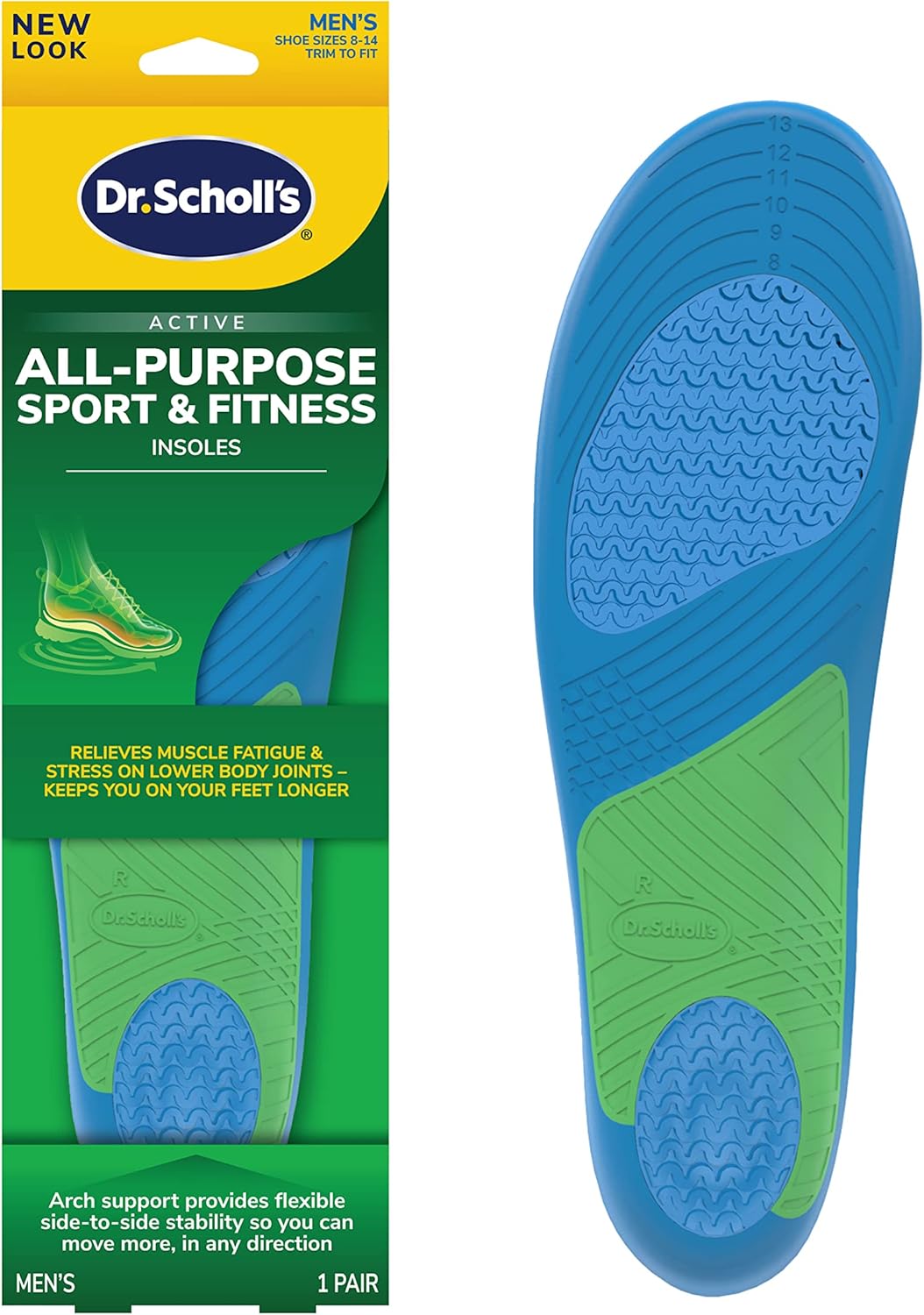
5) Dr. Scholl’s Sport Insoles – Best accessible everyday option
The Dr. Scholl’s Sport Insoles occupy a unique position in this lineup: they are the most universally accessible option and the one most players can walk into a grocery store or pharmacy and buy the same day. With 13,603 reviews and a price under $21, they represent the lowest-friction entry point into aftermarket insole use-and for players who have never used aftermarket insoles before, starting here and understanding what the upgrade delivers is entirely valid before committing to a premium option.
The flexible lateral support design is the feature most directly relevant to basketball. Unlike insoles designed purely for straight-line cushioning (running, walking), the Dr. Scholl’s Sport specifically addresses side-to-side movement-the flexible construction allows the insole to work with the foot during lateral cuts rather than resisting them. This is the design characteristic that separates sport-specific from general-purpose insoles, and it is the reason this model earns its spot on a basketball-focused list rather than just being a generic cheap option.
The shock absorption for lower body joint protection directly addresses the joint stress that basketball’s repeated impact loading creates. For players who experience knee, hip, or lower back fatigue during and after games, that joint protection function is meaningful beyond just foot comfort.
- Most accessible option on this list: Available at pharmacies, grocery stores, and online-lowest barrier to entry.
- 13,600+ reviews: Among the highest review counts on this entire list.
- Flexible lateral support: Designed for side-to-side movement specifically-not just straight-line cushioning.
- Lower body joint protection: Shock absorption designed to reduce stress on knees, hips, and lower back from impact loading.
- Multi-sport and multi-activity design: Works across basketball, fitness classes, and general athletic activity.
Best for: Players who want the most accessible entry-level upgrade from factory insoles, those who prefer to buy in-store immediately, and anyone who wants to understand what aftermarket insoles deliver before committing to a premium pair.
Worth knowing: The Dr. Scholl’s Sport provides cushioning and basic arch support, but lacks the structural rigidity of the Superfeet Green or the arch-matching precision of the CURREX RunPro. For players with specific arch or biomechanical needs, treat this as a starting point rather than a final solution.
See Current PriceOpens Amazon. Affiliate link.
What to look for in a basketball insole
The four features that matter most on the court
- Heel cushioning for impact absorption: Basketball landings from jumps concentrate force at the heel. Look for gel pods, composite heel construction, or a deep heel cup that works with the foot’s natural fat pad.
- Arch support that holds under lateral load: Running insoles support the arch in a straight-line push-off pattern. Basketball insoles need to maintain arch position through lateral cuts where the medial arch is torqued sideways. Rigid stabilizer caps (Superfeet) or reactive stability designs (Move Game Day) handle this better than soft foam alone.
- Forefoot flexibility: An insole that is too rigid through the forefoot limits explosive push-off mechanics. The best basketball insoles are firm in the heel and arch but allow natural forefoot flex.
- Durability through high-load sessions: Foam compresses. An insole that performs on day one may be providing minimal benefit by mid-season. Structural components (stabilizer caps, composite materials) extend useful life significantly over foam-only designs.
Arch support vs cushioning: which matters more for basketball?
Both matter-but they serve different purposes, and understanding the difference helps you pick the right insole for your specific needs.
Arch support is about structural positioning. A properly supported arch distributes impact load more evenly across the foot, reduces medial collapse during lateral movement, and protects the plantar fascia and Achilles tendon from overload. Players who experience arch pain, plantar fasciitis symptoms, or medial ankle fatigue benefit most from prioritizing arch support. The Superfeet Green and CURREX RunPro both prioritize structural arch support.
Cushioning is about impact attenuation. It reduces the force that travels up from each foot strike through the ankle, knee, and hip chain. Players who experience knee pain, hip fatigue, or general lower body fatigue during games often benefit more from cushioning improvement. The Move Game Day and Sof Sole Athlete both emphasize cushioning alongside support.
For most basketball players, a balance of both is ideal-which is why the Move Game Day’s combination of composite heel cushioning and reactive arch stability is the most specific solution for court use.
Common mistakes when buying insoles for basketball
- Buying an insole that is too thick for the shoe. Many basketball shoes already have relatively thick stock insoles. Adding a full-length insole that is too thick will make the shoe feel tight and restrict circulation. Check the available depth in your shoe before buying a high-profile insole.
- Using running insoles for basketball-specific movement. Running insoles are optimized for straight-line, heel-to-toe mechanics. They do not address the lateral cutting forces that basketball generates. The best running insole may still be suboptimal for basketball if it lacks lateral stability features.
- Ignoring arch profile when buying. A high-arch insole in a low-arch foot creates a pressure bridge that causes more discomfort than the factory insert. Match the arch profile to your foot-particularly important with CURREX and Superfeet options.
- Treating insoles as permanent once installed. All insoles compress over time. Replace performance insoles when you start to feel the original problem symptoms returning-typically every 300-600 hours of use depending on material quality and body weight.
- Expecting insoles to fix a shoe that does not fit. Insoles improve a correctly-fitting shoe. They cannot compensate for a shoe that is too narrow, too wide, or structurally wrong for your foot shape.
Q&A
Do insoles really help for basketball?
Yes-meaningfully so, for most players. Factory insoles in basketball shoes are generic and compress quickly. Aftermarket insoles designed for high-impact athletic movement provide better heel cushioning for jump landings, better arch support for lateral cuts, and longer-lasting performance across a full season. The difference is most noticeable for players who experience foot fatigue, arch pain, or knee soreness during or after games.
What insoles do NBA players use?
Many professional players use custom orthotics fitted by team podiatrists. For consumer-available options, the Move Game Day is explicitly co-designed with NBA professionals including Damian Lillard and trusted by players across the league as an accessible high-performance option.
Are insoles good for plantar fasciitis in basketball shoes?
Yes-arch support insoles that prevent medial arch collapse can significantly reduce plantar fasciitis strain during basketball. The Superfeet Green and the Move Game Day are both specifically mentioned as effective for plantar fasciitis management. Severe cases should be addressed with a medical professional alongside insole use.
How often should you replace basketball insoles?
Roughly every 300-400 hours of court time for foam-primary insoles like the Sof Sole Athlete, and every 500-600 hours for structural insoles with stabilizer caps like the Superfeet Green. The practical signal to replace: when you start to notice foot fatigue returning to pre-insole levels during sessions, the insole has likely compressed past its useful support range.
Can you use the same insoles across multiple pairs of basketball shoes?
Yes-most aftermarket insoles are trimmed to fit and can be moved between shoes of the same size. This is one of the advantages of premium insoles like the Superfeet Green: the investment follows you across multiple shoe rotations rather than being tied to one pair.
Bottom line
For basketball-specific performance, the Move Game Day is the most directly optimized choice-designed for hardwood movement by people who play at the highest level. For the most proven structural arch support with industry-leading durability, the Superfeet Green is the benchmark. For arch-matched precision fit, the CURREX RunPro is the most anatomically targeted option. For value performance at roughly $25, the Sof Sole Athlete delivers the most of that tier. And for the most accessible starting point, the Dr. Scholl’s Sport is the right pick to understand what aftermarket insoles actually do before investing in premium options.
The factory insert in your basketball shoe is a placeholder. Any of these five options will give your feet more of what a long game actually requires.