A pitching machine removes the one variable that ruins most batting practice: human fatigue. Every live-arm BP session eventually degrades-the pitcher gets tired, the mechanics change, and hitters end up adjusting to bad pitches instead of reinforcing good swing decisions. A pitching machine throws the same pitch to the same spot at the same speed, rep after rep, for as long as you want. That consistency is what makes them genuinely useful for player development at every level.
The challenge is that baseball pitching machines range from $50 kids’ toys to $5,000+ professional training systems, and the right choice depends almost entirely on who’s using it, for what purpose, and at what level. A machine that’s perfect for a Little Leaguer’s backyard is completely wrong for a high school travel team, and the premium three-wheel machines used by college programs are overkill for recreational youth practice.
This guide covers five of the best baseball pitching machines available on Amazon right now, across different price points, user levels, and use cases.
FTC Disclosure: This article contains affiliate links. We may earn a commission if you buy through them, at no extra cost to you.
Quick picks
| Pick | Best for | Speed range | Standout feature |
|---|---|---|---|
| Furlihong 380BH Pitching Machine | Best for young kids and beginners | ~20 mph | Battery powered, 370+ reviews, sting-free balls included |
| PowerNet Launch F-lite | Best mid-range all-purpose machine | 40-90 mph | Baseball and softball combo, variable speed, portable |
| Personal Pitcher Pro | Best compact at-home machine with pitch variety | Variable | Throws curveballs, sliders, and fastballs with small balls |
| Jugs BP1 Combo Pitching Machine | Best serious team machine | 15-70 mph | Digital readout, 70 mph capability, 360° swivel base |
| Junior Hack Attack Baseball Pitching Machine | Best premium machine for serious development | Up to 70+ mph | 3-wheel design, realistic pitch delivery, 311 reviews |
The 5 best baseball pitching machines
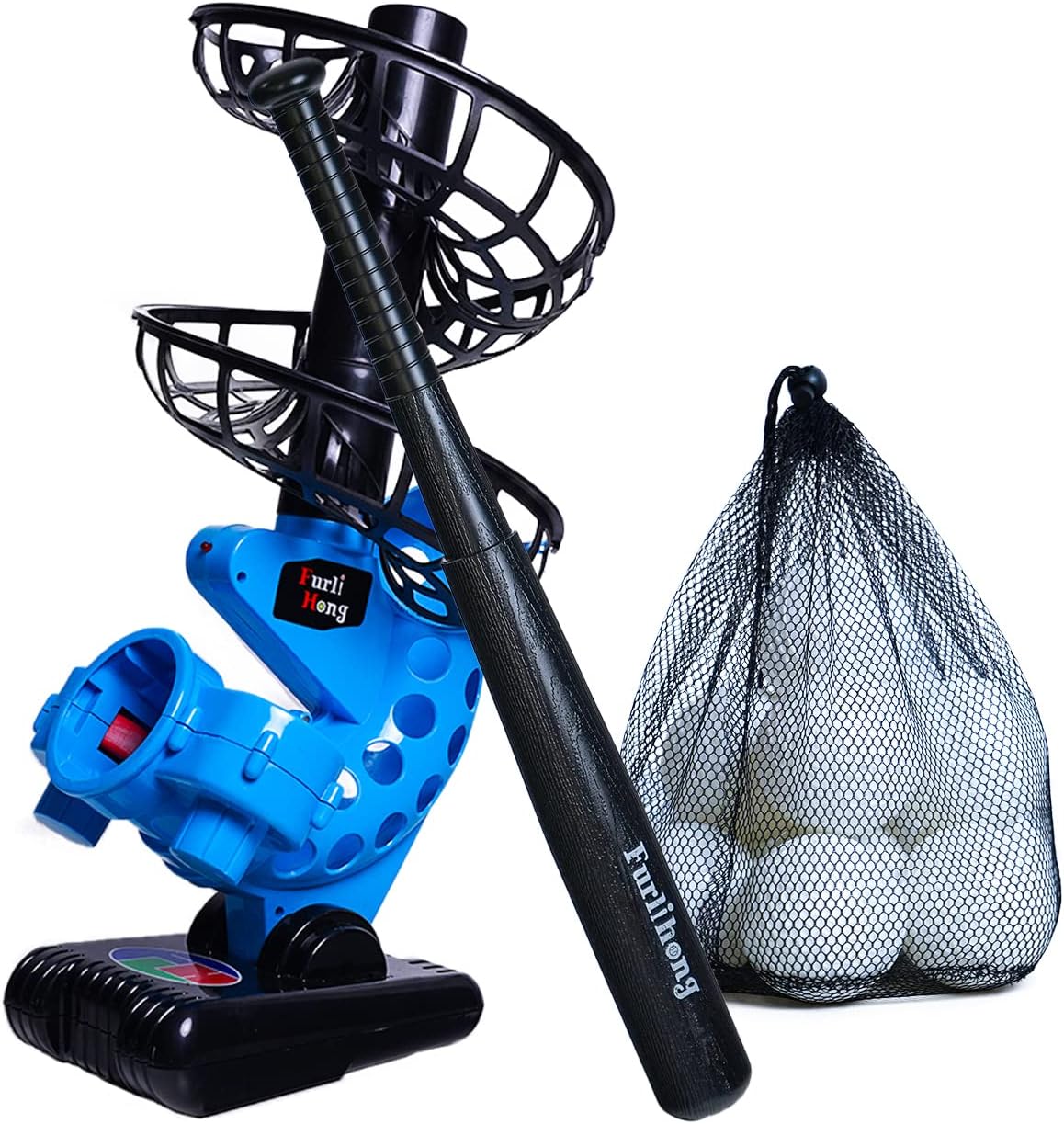
1) Furlihong 380BH Baseball Pitching Machine – Best for young kids and beginners
The Furlihong 380BH sits at the entry end of the category-and it’s there on purpose. It’s built around the specific needs of young, beginning players: a slow, consistent pitch around 20 mph delivered from a realistic angle, using soft sting-free training balls that won’t hurt small players and won’t dent aluminum bats. Battery-powered operation means no need for an electrical outlet, which makes it genuinely useful for a backyard, a park, or any open space where you want to set up a hitting station without worrying about power access.
The machine comes with a dozen 9-inch sting-free training balls, three adjustable launch angles, and an automatic feeding system that delivers pitches every seven seconds. That seven-second interval is a meaningful detail-it’s short enough to maintain timing rhythm but long enough for a young hitter to reset between swings. With over 370 reviews, it’s one of the better-reviewed youth pitching machines in this category, and the value relative to what it costs is hard to argue with for its target audience.
- Battery powered (4 D batteries): No power cord needed-works anywhere, from the backyard to a park field.
- 20 mph safe-speed delivery: Appropriate speed for young beginners developing timing and eye-hand coordination without fear.
- Sting-free training balls included: A dozen proprietary balls that are safe for small players and won’t damage bats.
- Three adjustable angles: Lets you calibrate pitch height for different player ages and sizes.
- Seven-second pitch interval: Consistent rhythm that gives young hitters time to reset and stay in their routine.
Best for: Parents of young children (roughly ages 5-10) who want a genuine backyard pitching machine for developing basic timing and swing mechanics. Also useful as a first machine before a player outgrows it and moves to a full-speed system.
Worth knowing: At 20 mph, this machine has a hard ceiling. A player who develops quickly will outgrow it within a season or two. For older youth players or anyone who’s already hitting full-speed pitching, the PowerNet Launch F-lite or Jugs BP1 are the more appropriate step-ups.
See Current PriceOpens Amazon. Affiliate link.
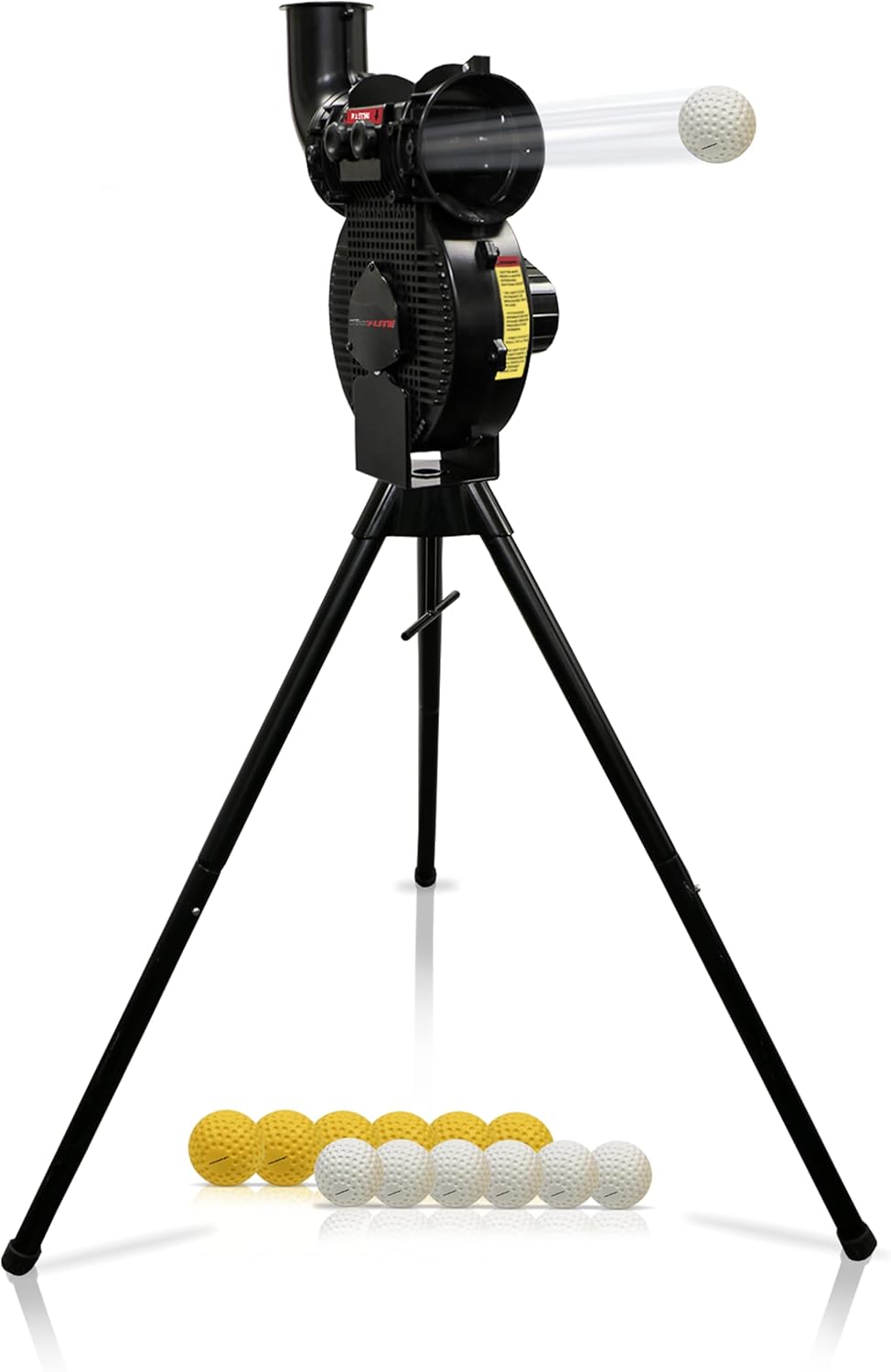
2) PowerNet Launch F-lite Baseball & Softball Pitching Machine – Best mid-range machine
The PowerNet Launch F-lite occupies the practical middle of the market-it handles both baseball and softball, spans a genuine speed range from 40 to 90 mph at 25 feet, and is built for coaches and parents who need a machine that can run realistic batting practice rather than just serve balls at a fixed slow speed. Four adjustable speed settings mean you can use this machine for everything from youth fundamentals work to competitive high school-level batting practice without buying separate equipment for different scenarios.
The combo design is a significant practical advantage: the interchangeable tripod base legs allow you to set it up for baseball or softball heights, and both ball types are included. For programs that serve multiple players across different sports, or for families with kids playing both, that versatility eliminates the need for two separate machines. The machine’s pop-fly and line-drive capability-not just ground-level pitching-adds a fielding drill dimension that many single-wheel machines don’t offer.
- 40-90 mph variable speed: Covers the full range from youth development through competitive high school training in a single machine.
- Baseball and softball combo: Works for both sports with included balls and interchangeable setup-practical for multi-sport households or programs.
- Pop-fly and line-drive capability: Not just batting practice-can be adjusted for fielding drills, expanding the machine’s training utility.
- Four adjustable speed settings: Simplifies session management without requiring continuous manual adjustment between pitches.
- Portable design: Built to be moved between field and storage without requiring permanent installation.
Best for: Travel ball families, coaches running multi-level youth programs, and any player development situation that needs serious speed range without the expense of a premium three-wheel machine. The strongest all-around value at the mid-price tier.
Worth knowing: The PowerNet uses dimpled practice balls rather than regulation baseballs. The feel is different from hitting a real baseball, which is worth knowing for players specifically training their swing feedback for game conditions. For that purpose, the Jugs BP1 handles regulation balls.
Check PriceOpens Amazon. Affiliate link.
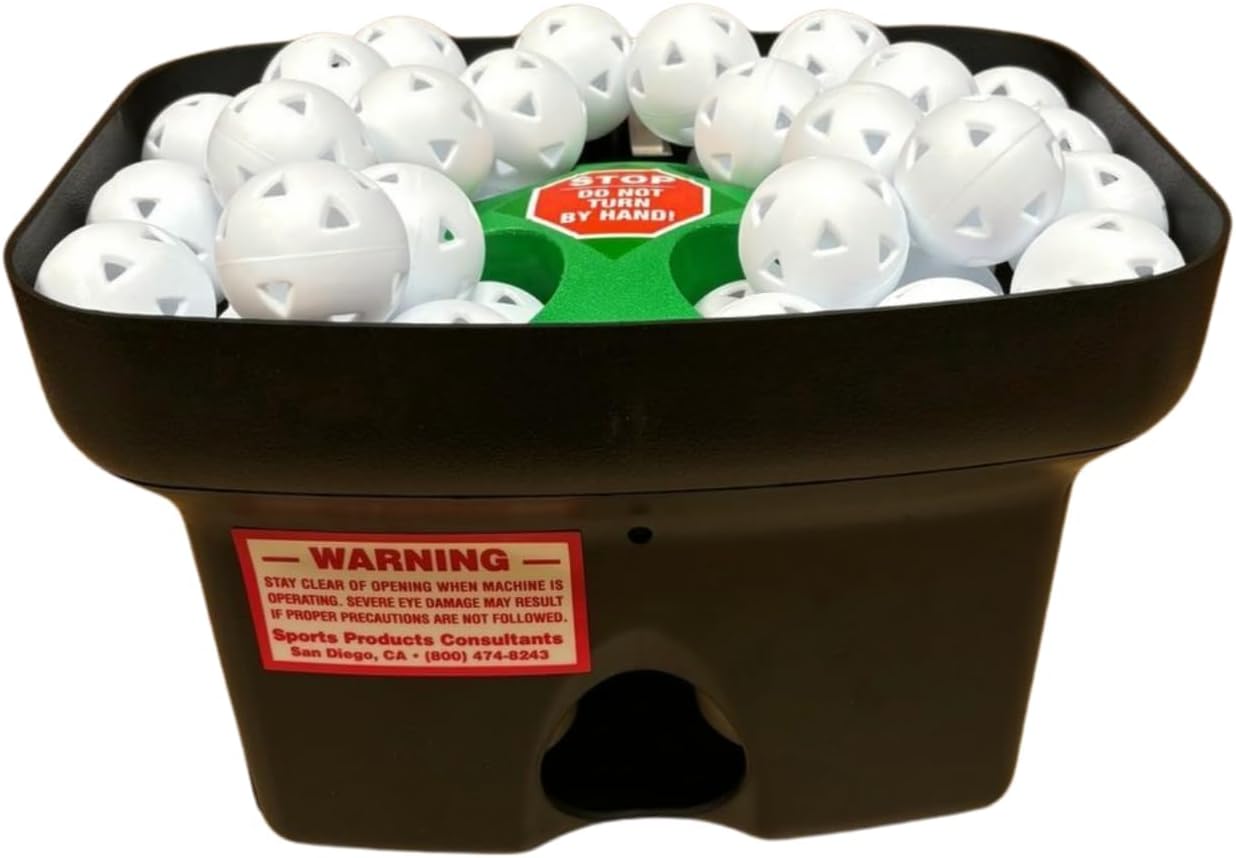
3) Personal Pitcher Pro Pitching Machine – Best compact at-home machine with pitch variety
The Personal Pitcher Pro stands out in this lineup for one specific reason that most pitching machines at this price can’t match: it throws curveballs, sliders, and fastballs. Not just straight fastballs at variable speeds, but genuine breaking ball movement produced by loading the small balls at different angles in the machine. For hitters who want to work on pitch recognition, two-strike approach, and breaking-ball tracking-not just swing mechanics on straight pitches-that capability is genuinely uncommon at this price point.
The machine uses golf ball-sized training balls rather than regulation baseballs, which makes it safe for indoor use or tight backyard setups where a full-speed baseball would be dangerous. It weighs only seven pounds and is designed for maximum portability. The trade-off is that the small proprietary balls feel different from game balls, and some hitters find the transition back to hitting regulation pitching requires adjustment. But as a tool for pitch recognition, arm-side development, and sheer volume of swings in a small space, the Personal Pitcher Pro fills a niche that most machines in this category don’t address.
- Throws curveballs, sliders, and fastballs: One of the only machines at this price that delivers genuine pitch variety for recognition training.
- 48 golf ball-size training balls included: Safe for indoor or confined spaces-eliminates setup requirements of a full batting cage.
- Seven-pound portable design: Lightweight enough for truly portable use-travels easily between locations.
- Adjustable speed for skill levels: Variable settings let it serve multiple age groups and development stages.
- Pitch recognition training value: Breaking ball capability lets hitters work on the hardest skill development challenge in batting-reading pitch type and location early.
Best for: Players who want to work on pitch recognition and breaking ball response at home or in a confined space, coaches who want a portable supplement machine for varied batting practice, and any setup where space or power limitations make a full batting cage impractical.
Worth knowing: The small balls and lighter weight are trade-offs for the portability advantage. This machine won’t replicate the feel of hitting regulation pitching, and the breaking ball movement is produced by the ball shape, not a genuine arm-delivery simulation. Think of it as a pitch recognition training tool more than a pure swing mechanics machine.
See ReviewsOpens Amazon. Affiliate link.
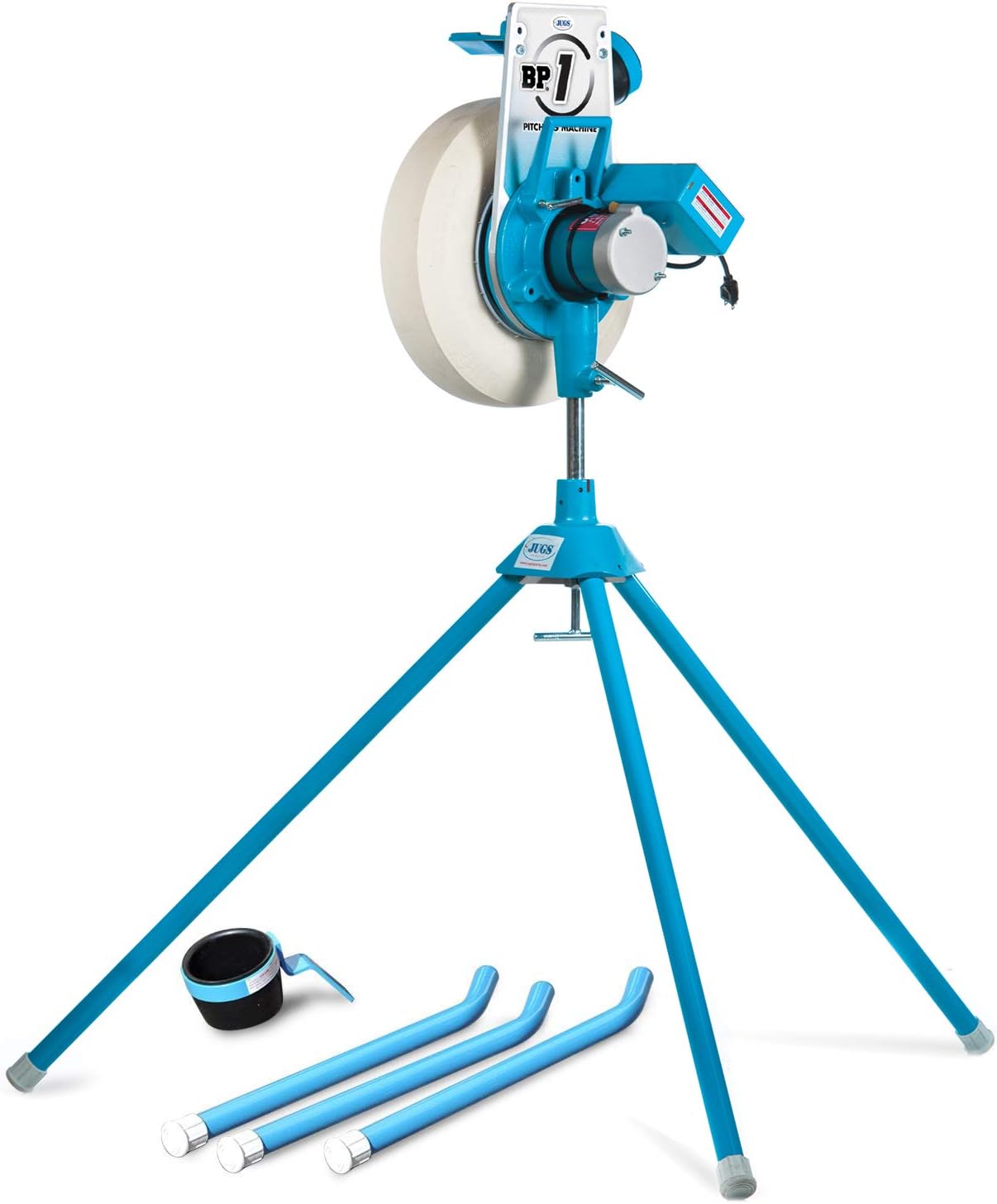
4) Jugs BP1 Baseball/Softball Combo Pitching Machine – Best serious team and club machine
Jugs is one of the most recognized names in pitching machine technology, and the BP1 is their entry into the serious team-use category. At 15-70 mph with a digital readout that lets coaches set the exact speed they want, it’s a fundamentally different category of equipment than portable consumer machines. The digital precision matters for structured batting practice-you’re not approximating; you’re selecting 52 mph for a specific development drill and getting 52 mph, consistently, until you change the setting.
The 360-degree swivel base adds a fielding dimension that most machines don’t have. By pointing the machine upward and at different field angles, coaches can generate pop-ups, fly balls, and line drives for outfield and infield drills, not just batting practice. The machine handles 11″ and 12″ softballs, baseballs, and Jugs’ sting-free dimpled training balls, giving coaches ball-type flexibility without equipment changes. For high school programs, travel ball organizations, and serious individual development setups, this is where baseball training equipment starts to feel genuinely professional.
- 15-70 mph with digital readout: Precise speed control that eliminates guesswork-set it exactly and trust the consistency.
- 360-degree swivel base: Pop-ups, fly balls, line drives, and ground balls all become possible from one machine position.
- Baseball and softball compatible: Handles multiple ball types without separate attachments or configuration changes.
- Jugs two-year guarantee: Brand backing that reflects confidence in the machine’s durability under regular team use.
- Runs on AC or generator: Designed for field use where power access varies-compatible with portable inverter generators.
Best for: High school programs, travel ball teams, and serious training facilities that need a professional-grade machine with precise speed control, fielding drill capability, and durability for regular heavy use.
Worth knowing: At roughly $1,800, the Jugs BP1 is a significant investment appropriate for team budgets or committed individual setups. For recreational family use, the PowerNet Launch F-lite delivers substantially similar batting practice functionality at a fraction of the cost.
See Current PriceOpens Amazon. Affiliate link.
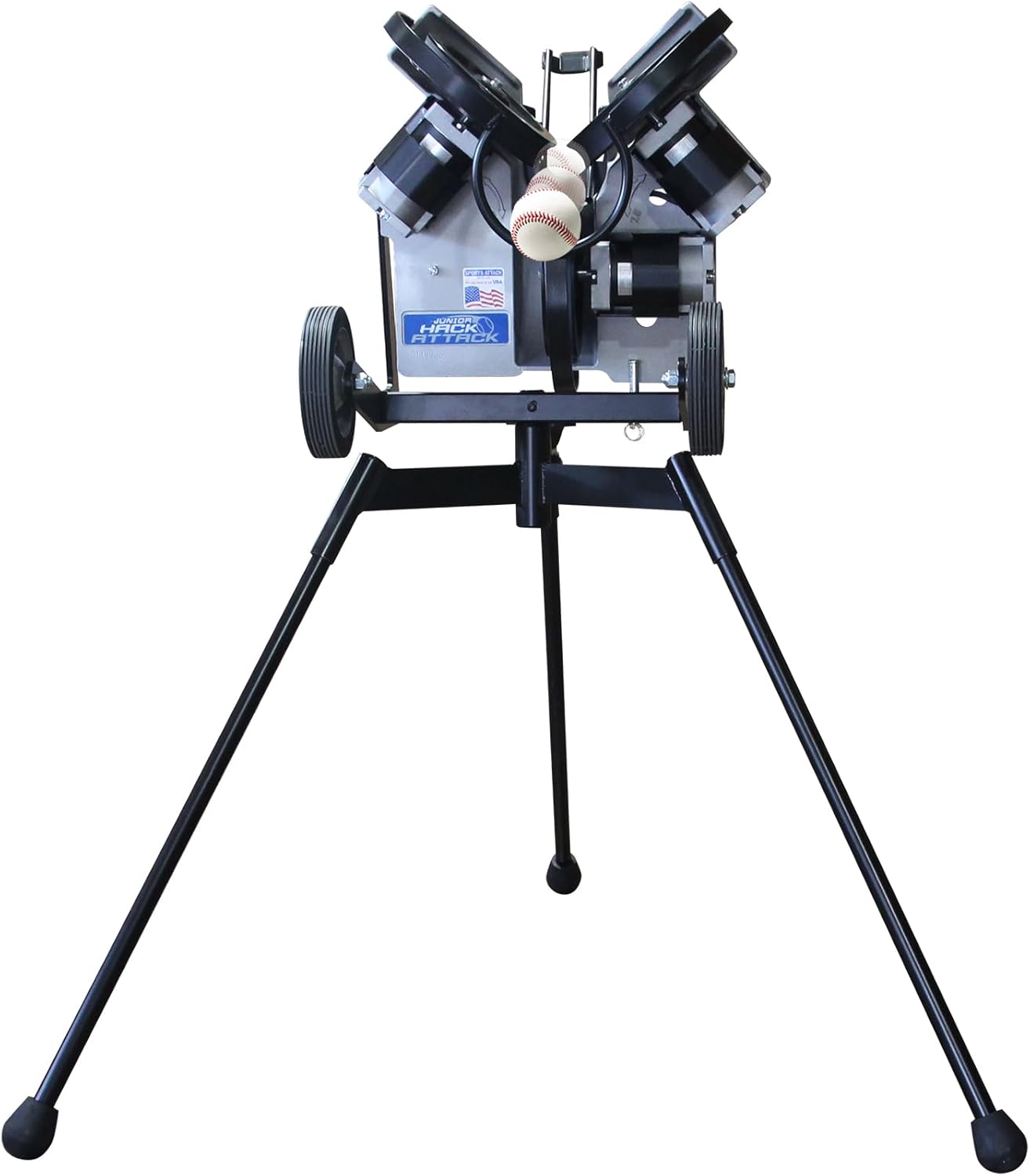
5) Junior Hack Attack Baseball Pitching Machine – Best premium machine for serious player development
The Junior Hack Attack is from Sports Attack, the company behind the Hack Attack line used by professional and college programs across the country. The “Junior” version is built for youth and high school players who need the pitch quality of a professional machine at a scale appropriate for their development level. Three-wheel pitching machines-which is what this is-are categorically different from single or dual-wheel designs because they can deliver realistic pitch movement from a delivery point that more closely mimics the release point of a live pitcher.
Where most consumer machines deliver straight pitches at variable speeds, three-wheel machines can replicate curveballs, sliders, changeups, and two-seam movement that train hitters on the pitch recognition and barrel path adjustments they’ll actually face in games. For players in competitive youth leagues, high school baseball, or travel ball programs where the development goal is genuine game-readiness, the Junior Hack Attack is the machine that most closely replicates live pitching. The 311 reviews at this price point is strong evidence that serious baseball families and programs are investing in this level of equipment-and finding it worthwhile.
- Three-wheel design: The mechanical differentiation that enables realistic breaking pitch delivery from a life-like arm height-categorically different from single-wheel machines.
- Sports Attack professional pedigree: From the same company whose Hack Attack machines are used by MLB organizations and top college programs.
- Pitch type variety: Fastballs, curveballs, sliders, and changeups-not just variable-speed straight pitches.
- Adjustable pitch location: Inside, outside, up, and down-allows coaches to work specific pitch locations and zones systematically.
- Portable design for a premium machine: Built for transportation between field and storage despite its more sophisticated mechanics.
Best for: Serious competitive players from youth travel ball through high school who need realistic pitching to develop at the level their competition demands. Programs that want to invest in equipment that matches their development goals rather than settling for the mechanical feel of a consumer machine.
Worth knowing: At roughly $2,600, the Junior Hack Attack is the premium investment on this list. The cost is justified for programs and serious development-focused families-but it’s genuinely overkill for casual backyard use or recreational youth leagues where the other picks deliver excellent value for far less.
Check PriceOpens Amazon. Affiliate link.
What to look for in a baseball pitching machine
Speed range and realistic pitching
The speed range a machine covers determines which players can use it effectively. Youth machines in the 20-45 mph range work for players who are still in early development stages. Machines that reach 70-90 mph are necessary for players facing competitive pitching. More important than top speed is consistency-a machine that throws 65 mph every time is more useful for development than one that fluctuates between 58 and 72 mph.
Single wheel vs two-wheel vs three-wheel
Single-wheel machines are the most affordable and portable but can only throw fastballs. Two-wheel machines can replicate a limited curve or slider effect and handle more ball types. Three-wheel machines-like the Junior Hack Attack-can deliver realistic breaking ball movement from a life-like delivery height, which is what makes them the choice for serious development. The price difference reflects the mechanical complexity and realism each design offers.
Power source
Consumer machines are typically battery-powered or plug into 110-volt AC. Battery operation gives maximum portability. AC-powered machines are more reliable for sustained team use but require access to power at the field. Some premium machines like the Jugs BP1 are compatible with portable generators, which covers both needs.
Ball compatibility
Some machines require proprietary balls-either for design reasons (the Personal Pitcher Pro’s small balls) or safety reasons (sting-free training balls at high speeds). Machines that accept regulation baseballs provide the most authentic training feedback. Check what ball type each machine requires and factor in ongoing ball cost and replacement logistics.
Single-wheel vs three-wheel machines: key differences
The comparison that matters most for serious players and programs is between single-wheel consumer machines and three-wheel professional-grade systems.
Single-wheel machines (PowerNet, Furlihong) are affordable, portable, and consistent at delivering straight fastballs across a speed range. They’re excellent for swing mechanics development, timing work, and volume batting practice. Their limitation is that they can’t replicate the pitch movement and delivery height of live pitching.
Three-wheel machines (Junior Hack Attack) deliver pitches from arm height with realistic breaking ball movement. They’re built for players who need to practice pitch recognition-reading curveball vs. fastball vs. slider early out of the delivery-not just swinging at straight pitches. For competitive baseball at the high school level and above, that distinction is significant.
For most families and recreational programs, a quality single-wheel machine delivers excellent value. For players in competitive travel ball or high school programs where pitch recognition is a genuine performance factor, the step up to three-wheel delivery is where the development edge actually comes from.
Common mistakes when buying a baseball pitching machine
- Buying for a player’s current level, not where they’ll be in one or two years. Players develop faster than most parents expect. A machine appropriate for an 8-year-old today will be inadequate by age 10. Budget and spec accordingly.
- Choosing a machine that requires proprietary balls and then running out. Check ball availability and cost before buying. If replacement balls are hard to find or expensive, it becomes a recurring friction point.
- Assuming higher price always means better for the specific use case. A $2,600 three-wheel machine is not better for a 7-year-old learning to make contact than a $150 battery-powered youth machine. Match the tool to the actual training need.
- Neglecting the power source problem. Many family buyers don’t realize their intended field doesn’t have power access. Battery-powered machines solve this-but have limited run time per battery set. Confirm the power logistics before purchasing an AC-only machine.
- Underestimating setup and maintenance time. Premium machines require more time to set up, calibrate, and store than consumer machines. For coaches running large practice sessions, that time compounds. Factor in operational simplicity alongside mechanical capability.
- Skipping a cage or backstop. A pitching machine without a proper ball stop creates a dangerous, chaotic setup and means you’re chasing balls constantly. Budget for netting or a batting cage alongside the machine itself.
Q&A
What is the best baseball pitching machine?
For most families and youth programs, the PowerNet Launch F-lite is the best all-around pick-it covers the speed range from youth development to competitive training, handles both baseball and softball, and is built for real batting practice rather than introductory play. For serious competitive players, the Junior Hack Attack is where realistic pitch training begins.
Are baseball pitching machines worth it?
For players who practice regularly, yes. The consistency of a machine-same pitch, same speed, same location-accelerates skill development in ways that inconsistent live batting practice can’t replicate. For players who only practice occasionally, a pitching machine’s investment may not be fully utilized.
What speed should a pitching machine be for youth baseball?
For players in the 7-9 age range, 20-35 mph is appropriate. For 10-12 year olds in Little League, 40-55 mph is more realistic to game-speed pitching. High school level players benefit from 60-70+ mph capability. Match the machine’s speed ceiling to the competition level the player is preparing for.
Can a pitching machine throw breaking balls?
Yes-but only certain machines. Single-wheel machines typically cannot replicate genuine breaking ball movement. Two-wheel machines can throw limited curves. Three-wheel machines like the Junior Hack Attack deliver realistic curveball, slider, and changeup movement from a life-like delivery height. The Personal Pitcher Pro also throws breaking balls using its small proprietary balls at reduced speeds.
How long does a pitching machine last?
Quality machines from established brands like Jugs and Sports Attack can last 10-20 years with proper maintenance. Consumer-grade machines have shorter expected lifespans under heavy use. Regular cleaning, proper storage, and following manufacturer maintenance guidelines significantly extend machine life at any price point.
Bottom line
For young beginners and backyard family use, the Furlihong 380BH is the most accessible starting point. The PowerNet Launch F-lite is the strongest mid-range pick for players who’ve outgrown beginner-speed machines. For compact at-home pitch variety, the Personal Pitcher Pro fills a unique niche with breaking ball capability at an accessible price. The Jugs BP1 is the right call for programs that need professional-grade speed control and fielding drill capability. And the Junior Hack Attack is the machine for serious competitive development where realistic pitch delivery is the training standard.
Match the machine to the player’s current level and where they’re headed-the right tool for the right development stage is what actually moves the needle on performance.